

Consider choosing public school
It's a good thing, both politically and otherwise

Hi all,
Below you’ll find an essay about schools. Thanks to all who participated in my survey, I really appreciate everything you shared. This is a long one, so you probably need to read it in the app or click “view entire message” at the bottom of your email.
In my next newsletter, I’ll be sending advice, and then a 10 things wrap up, and then back to an essay. I really appreciate anyone who takes the time to read, comment, like, email me, etc. — it genuinely means the world to me.
A note on paying for my newsletter: I know there are a LOT of newsletters out there — I subscribe to hundreds and obviously can’t financially support them all. But if you have ever gotten good advice, read something interesting that you may not have otherwise found, or learned something from one of my essays — or if you’re one of the people who opens and reads every email — I would love it if you subscribed for the price of a cup of coffee. It’s maybe cringe to admit but I spend many hours thinking about, working on, and writing these — it is work, and it means a lot to me. If it means something to you, please support my work by subscribing.
Love,
Your friend Mindy
PS: I am still hopeful about getting a Classifieds & Personals section up and running, but I have only gotten one submission so far. If you are looking for a date or workshop attendees or tenants (or something else entirely), send me an email at mindy.isser@gmail.com with the details (all info + how to get in touch!) and I’ll share it in my next newsletter.
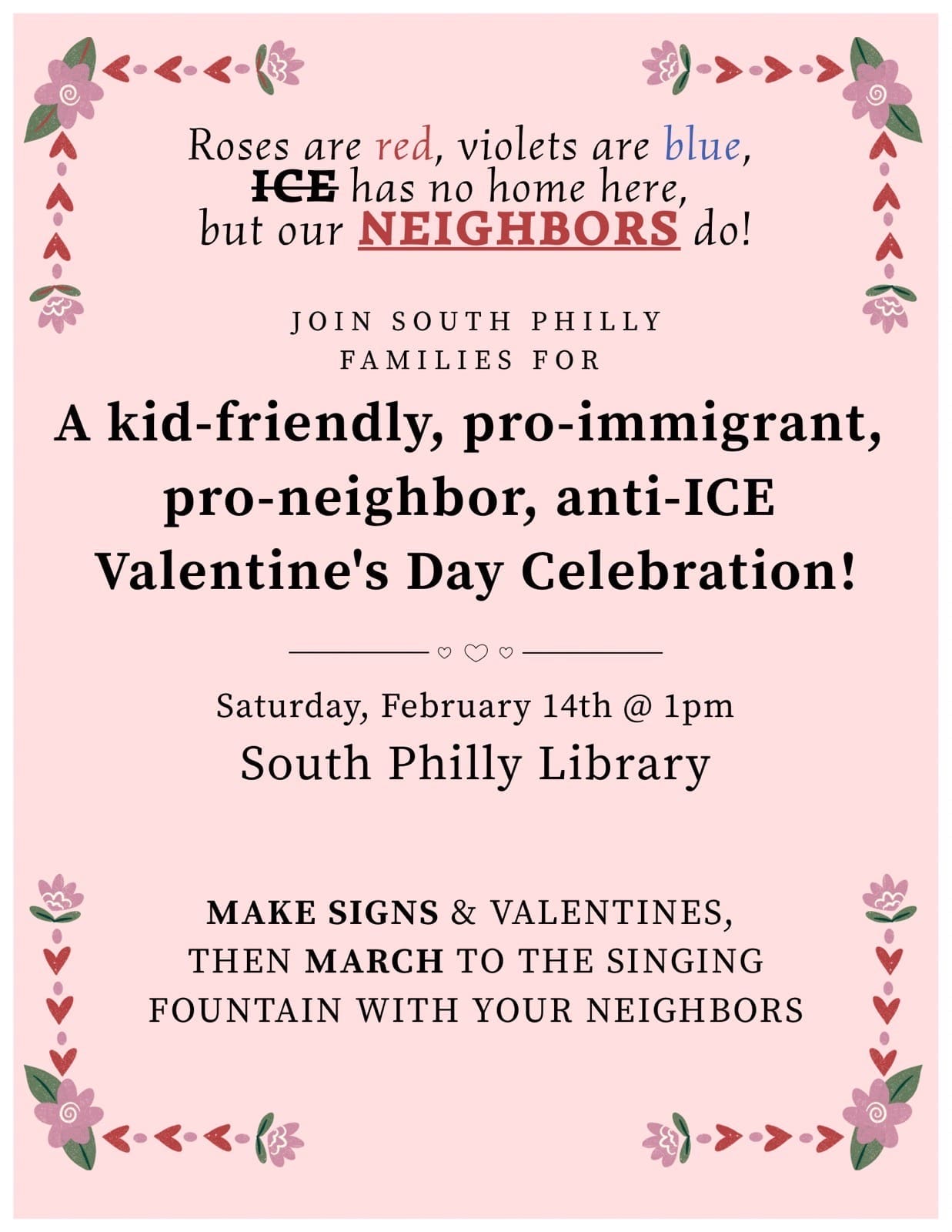
PPS: If you have kids and live in Philadelphia, join us on Valentine’s Day:
Thank you to KL, EL, and LS for feedback and edits on previous drafts of the below essay.
Our son has been asking about his “big kid school” a lot — a few of his friends left his daycare in September for Kindergarten so we think that’s why. On MLK Day last month, the Home and School Association at our neighborhood elementary school hosted an event — a recording of an MLK speech, speakers, and a school clean-up — so we walked the five blocks over. I wanted our son to see his future school and to imagine himself in it, as best as a 3 year old can do something like that. The building is huge and gorgeous, and sadly under-enrolled — it used to house a junior high instead of our future elementary school. But in 2010, that junior high was closed, and so was a neighboring elementary school (this building, which is two blocks from our house, is now apartments). The District moved the elementary school students to the old junior high building, and changed the name to reflect this. (A second neighborhood elementary school was closed when the School Reform Commission closed 30 public schools between 2012-2013; those kids were also sent to my child’s future school. Even though these closures did not save the School District of Philadelphia a significant amount of money, the District is planning to close even more schools starting in 2027.)
In “Letter from a Birmingham Jail,” MLK wrote, “We are caught in an inescapable network of mutuality, tied in a single garment of destiny.” If I had to sum up my politics in one sentence, it would probably be that one. Whether you have a child or not, and whether you send that child to public school or not, public education affects all of us. And because public schools (and public school teachers) are under attack, it’s up to us to fight like hell to defend it. But to defend it — really defend it, not just make a superficial “of course I support public schools!” comment — we have to use it, engage with it, and work to improve it.
We all know that Trump and his privatizer friends are dead-set on destroying public education solely because it’s public. The best thing about it — that it’s for everyone, including the very poor — is the reason it’s on the chopping block. They want to eliminate Title 1 funding, they want to have private school vouchers in every state, they want to be able to discriminate against LGBTQ+ students, they want to ban books, they want undocumented kids to be too afraid to go, and they want to bust the unions that represent a mostly female workforce. Public school and its teachers deserve our support and protection, and we can’t provide it in the same way if we aren’t in it. How can you say this is a system worth defending if it’s a system that you’re willingly opting out of? Families inside the public school system are the ones with the power to change it, especially families with resources — not just money (although that too) but education, time, and connections — which are unfortunately the families most likely to choose private school.
At my union’s holiday party at a casino in suburban Maryland, I started chatting with a guy who turned out to hate unions (he came over to us to compliment my coworker’s outfit). We argued for a while in a good-natured kind of way, and then found common ground around the fact that we were both parents. I asked him about school and he said, “I live in Baltimore City, you have to send your kids to private school, everyone does.” Admittedly, I know nothing about Baltimore besides Camden Yards and eating crabs, but I do know that thousands of families send their children to Baltimore City public schools, otherwise they would not exist.
Once someone who disagreed with my position on public schools said something like, “you can let your child be a political experiment if you want, but I’m not going to do that to mine.” I feel very certain that this person would never say something like that to a poor person of color (who make up the majority of families that send their kids to Philly public schools), but felt comfortable saying it to me because it’s assumed that I have options. It is true, I do have options. We could have moved to the suburbs for “better schools,” but we don’t see the city as something you live in “as kids” but then leave when it’s time to “grow up.” It has its problems but so do the suburbs; we genuinely love it here and we aren’t going anywhere. We could figure out a way to afford private school, but we’d stop donating and saving the way we do, and we’d stop hosting parties and having anything “extra.” Other families have probably made a calculation that that’s a small price to pay to avoid public school, but we feel differently. We don’t know what we’d be paying for. I’m just not convinced that, on the whole, private school is any better than public.
To be clear: going to public school is far from an experiment — it is actually the the most normal thing in the world. Only about 10% of children in this country attend private school. I constantly repeat this number to myself because far more than 10% of people I know either send their kids to private school or are planning to when they get older. So much comfort I’ve found in parenting has been by crowdsourcing information from my friends and other peers, like: Is it developmentally appropriate that he hits/bites/spits/tell us to shut up? Is he going to hate us for not giving him a sibling? Is it normal he’s still in a pull-up overnight? But decisions around schools can turn this on its head. While my friends who choose private school may feel judged by my beliefs, there have been many nights I look for reassurance from my husband: Are we doing the right thing? Are we bad parents for not sending him to private school? Do our friends think we’re bad parents for choosing our neighborhood school? My husband is never worried about what other people are doing (dad privilege!) and says as much.
But this peer-to-peer guidance and support also works in the other direction. Fanny Jackson Coppin School is a 6 out of 10 on the (evil) GreatSchools website. That’s obviously not a great rating! But somehow it doesn’t matter — people are clamoring to send their children there. A friend bought a new (and much more expensive) home six blocks away from her old house, just to make sure she was living squarely in Coppin’s catchment, while others use the public school lottery for their chance (I’ll probably get into the school lottery in another post, as this is already a long one). The school’s reputation was completely different a decade ago, and the school’s makeup has changed significantly over time. Similarly, Southwark, which was just in the news for abysmal building conditions and has a 5/10 rating on GreatSchools, has families desperate to get in, primarily for its Spanish Immersion program. I believe gentrification happens mostly above the consumer level, but you can see how the process occurs with schools: one white family decides to send their kid, more follow. To be clear, this is a good thing! It’s just also arbitrary.
So much of the decision around schools comes down to vibes, quite frankly. There’s a lot of “oh, you sent your kid there? I guess I could too.” Seeing parents who are a year or two or three ahead of you in the process send their kids to their neighborhood public school gives people the permission, comfort, and guidance to do the same. This is a good thing, but there’s a core of ugliness in it, too: it’s our social connections, of course, but also racism and classism and fear. I don’t blame anyone for their concerns about public schools, I have them too. Many are legitimate and the rest are bred from issues in our society and inside of us that we should feel called to struggle against — especially those of us with left-wing politics. When I was at City Hall for the introduction of ICE OUT legislation a few weeks ago (which now has a veto-proof majority, thank you to all who worked on this and made phone calls!), there were students from Friends Select School, a private Quaker school downtown. They were there speaking on behalf of “Social Justice Week” (lol whatever, another topic for another day). The two kids were clearly smart and well-spoken and had hearts of gold, my beef is not with them. But it’s like nails on a chalk board to hear people speak about equity and justice in Philadelphia when they attend a school that costs more per year ($53,000) than city residents’ per capita income ($38,905). The most equitable thing in the world is public school, and if you’re concerned about equity, you should send your children there.
I’ve been deeply moved by how the public school system in Minnesota is mobilizing to protect children, families, and even staff from ICE. (I challenge you to read this article without crying.) Two school districts and the teachers’ union are suing to keep ICE away from schools. I know that public school teachers here in Philly are seriously preparing for an ICE occupation, and working hard to keep kids safe. I have no doubt that many private school parents and teachers care deeply about the fate of undocumented children. But I think Lisa Sibbett’s note is correct, even though I know it’s also provocative:
If you live in an area where you have neighbors who might be targeted by ICE, one of the very best ways you can be prepared to have your neighbors’ backs is by enrolling your kids in your neighborhood public school.
Yesterday we had a big ICE scare in my part of Seattle. It turned out to be a false alarm (for now), but a whole bunch of our local public schools had to go on lockdown for most of the day. Many kids and families were terrified.
I was driving home through the city in the afternoon as schools were getting out. In front of the public schools, there were groups of teachers, parents, and students demonstrating against ICE and prepared to defend their communities.
Outside the private schools I drove past, nothing. They may not have even known about the scare. They were so much less likely to be targeted. Their community had no opportunity to be part of the defense. It’s not that people at private schools don’t care, it’s that they are not involved in the same way in what’s happening in civic society.
Opting out of your neighborhood school means opting out of your neighborhood community. And this comes with costs to the connection and leverage you will have when things go sideways for you or your neighbors.
If I had to guess how many undocumented students were in private schools in the Philadelphia area, I’d say, generously, five. The fact of the matter is that undocumented students are educated by the public school system, and will be defended by it. I am sure private school parents are equally as horrified as public school parents about ICE’s attack on undocumented students, but because their children don’t go to school with them, there’s less at stake for them, and they have less skin in the game. You better believe that if ICE is at my child’s school, I will be there too, defending him and every other child in that building. That is “our single garment of destiny.”
And of course I understand that kids receive scholarships for all sorts of reasons, and there’s plenty of diversity at private schools (although this diversity is mostly racial, not economic). My husband went to private high school and for a long time donated to his alma mater’s specific scholarship fund focused on diversity because he knew it was important to make his experience accessible to more people. But of course, not everyone is lucky enough to get a scholarship, and private school is exclusionary by its very nature, and not just financially. A friend’s sister was looking at a private school for her daughter for Kindergarten, and the school made it clear she wasn’t “the right fit.” She is autistic. She is now excelling at her neighborhood elementary school, and so is a teenager with Down Syndrome who I just met — she loves her neighborhood public school and so does her mom. I am sure there are significant challenges to running and accessing these programs, but they exist for everyone solely because public schools are mandated to provide an education to every single student. Private schools are able to pick and choose who comes in their doors and who gets to stay.
Because I do not know what the future holds for my child (who is still a few years out from elementary school), this promise brings me a lot of comfort. I genuinely have no idea where he’ll excel and where he’ll be challenged, and I feel a lot of security knowing that no matter where he falls on that spectrum, he’ll have the support he needs to succeed. If he’s neurodivergent, has a learning disability, and/or is transgender, I know there are policies in place for him and other kids like him. (We discuss often how not surprised we’ll be if he eventually gets an ADHD diagnosis.) A lot of the posts I see urging people to give public schools a chance are on moral or political grounds. And yes, obviously I agree. If I had a dollar for every public school activist who actually sends their kid to private school, I’d unfortunately have more dollars than I should, and if I had one for everyone with “We Believe” signs in their window or otherwise liberal or leftist politics, I’d be rich. It is true that I’m not buying what you’re selling politically if you’re choosing an exclusionary environment for your own child. But I want to make a case for public school for what it is, not for what it signifies or stands for, although that’s important too.
A lot of arguments in support of public school are basically like, “Because of your socioeconomic status, your kid will be fine no matter what, so choose public school because it’s the right thing to do!” I agree and I have made this argument many times and will continue to do so. But I also want people to think about public school as less of a sacrifice that we make for our politics (or a choice we’re forced to make because of finances), and instead actually internalize that it’s just a genuinely good and normal place for your kid to get a solid education. I want people to truly believe that public school is a place children can, do, and will thrive.
152 people took my survey (thank you!), and 93 people identified themselves as public school parents. Below are some of the comments people left about their experience, all from parents in urban environments (not just Philadelphia). You can see they’re mostly positive, but also not without their challenges:
It reminds me of exactly my public school experience except with uniforms. We love the families we’ve met at the school and see them socially. As a family who has no family around to help with childcare, these people have really become our “crew” and “community.”
I went to kindergarten open house the spring before my kid started. I fell in love the minute I walked in. It reminded me of the elementary school I went to as a kid. Small class size. Very family oriented. HSA is a lot of fun! My kid is so happy and doing really well in school. She also goes to after care at the public rec center around the corner. it's $40 a WEEK for five days. Homework help, crafts, games, playground and a huge gym.
Good school! Teachers, staff, all great; resources somewhat limited, class sizes large, facility outdated, but strong parental support mitigates resource issues
I am a public school advocate and am very happy with the public schools in my city and neighborhood. My neighborhood public school (where my 5 year old goes and my 2 year old will go) is 66% Black. There is a charter school in the neighborhood that is 66% white, and my read on people who claim the charter is “better” is that they are mostly referring to racial demographics.
good - my son is gaining a lot from kindergarten at our public school. I love his teacher. I think they have enriching activities e.g. music (although they don’t get on their own instruments at this school), tech/science, art. They only have recess once per day, I wish it were twice and apparently that is due to staffing. Sometimes they don’t get recess even when the weather is ok for unclear (?staffing) reasons. I wish the class size was smaller or that there was an additional support teacher. I like that the school is diverse. He is thriving and according to the report card he is hitting the appropriate learning benchmarks.
We toured and I was underwhelmed, but we know many families that go there and their kids are happy and thriving. We more heavily weighed our neighbor’s years of experience at the school than our lackluster first impression. Im glad I did— the school community is the best thing about the school.
We have lots of friends with slightly older children who spoke very highly of the school. When visiting the school itself, it’s apparent that it is an underfunded public school. But also evident is how dedicated most of the teachers and staff are.
We didn’t know much about the school before visiting, but when we visited, we were impressed by how friendly and comfortable it was. Philly public schools have to make do with less, but the staff really goes above and beyond. Having our kid (and her sister next year) in our neighborhood school has gotten us more involved in the community, helped us meet new people, and really made us feel anchored in our neighborhood. The parents are super involved and welcoming, and my kid is thriving there.
We loved our school community, the small classroom sizes and the easy access to the staff. My eldest has all the requirements to apply for special admission schools or to go to a more science based private school and is choosing to stay all the way through 8th grade. That tells you how comfortable and how much he loves his school.
My second grader is thrilled with her school which is enough for me! She’s learning so much with a huge focus on critical thinking skills and essay writing. I remember my coursework in second grade (catholic school in the 90s) and she’s ahead of where I was at her age.
59 survey responders (38%) did not choose their neighborhood public school. But when doing a deeper dive, I found that:
17 of those families did actually choose public school, just not the one in their catchment (again, I’ll write an additional piece about the lottery system in the future)
16 chose private school
11 chose a charter school
4 chose a parochial or religious school
1 chose home schooling
10 were unsure what they were going to do, but they knew they weren’t going to their neighborhood school
Read below for comments from these parents, although please note I am only including responses from people who chose charter, religious, or private schools. (Like I said, I’ll tackle the school lottery in another newsletter.)
Our child is academically gifted and we concluded that the public schools were not equipped to focus on curriculum differentiation. We want our kid to be challenged even though they are ahead in math and reading.
It was not the best looking building esthetically and I knew that it would not be the best place for my son
We were not satisfied with the academics of the school, even though staff was really nice and we liked the diverse student body
The community is very engaged, the principal seemed very impressive. The facilities were very outdated. During the tour a deluge of water came out of the HVAC system right where the tour was meeting. It seems like despite a very engaged community the school is hampered by the politics of the broader public school system
We were preparing to send her there. Everything was actually quite nice and the school exceeded expectations. However, my father-in-law offered to pay for a religious education from K-8.
I toured two public schools and was very impressed with what I saw - everything was safe and functional. Current parents in the neighborhood only had positive, often glowing, feedback. The decision not to attend was based solely on one of our biggest family values, which I know not all families have the privilege to put into practice - my partner and I are deeply committed to raising a screen-free child. I could see, during the tour, that screens were a component of daily learning (at least in kindergarten). In one classroom, all kids were working on their own Chromebooks (I think, because the teacher was doing 1:1 instruction). In several classrooms, I could see Smartboards with many tabs open, i..e., Youtube videos. I know that technology is often necessary when other resources are limited. However, we had spent so much time and effort consciously avoiding screens that selecting this type of learning environment felt like it would be a step back.
Public school in Philadelphia was never a consideration.
Children need to learn. Philly schools aren’t teaching. These classrooms cannot be kept orderly because of poor behavior of students who aren’t paid attention to at home.
We were really considering it and had gotten in to the language immersion program. We wanted to visit the school, but missed the fall open house. We had to make a school decision before the spring one, so I emailed the school to see if I could set up a time and was told they do not do any tours outside those open houses. I know there are staffing constraints, but that was a turn off for me and left me feeling unable to make an informed decision about the school without seeing it. We applied to a mix of public, private, and charter and our decision came down to the wire and what we felt was best for our individual child at the time. We definitely see the pros and cons of different options. We ended up at a Quaker school and also found the values/ethos appealing.
We wanted to send our daughter to a more progressive school than the local public schools.
We always knew we wanted to send our kid to private school because we both went to private school. However, my friends kids go to public school are doing great.
I was open to public school and was hoping by the time we had kids the school district/Philadelphia would have caught up but unfortunately that wasn’t the case in our neighborhood. I know several areas of the city where the public schools are thriving but mostly it seems to do the demographics that have moved in to help the school with funding.
Neither myself nor my husband went to public schools so we didn’t have a strong conviction about it, and we make enough money that private is a viable option. We figured we’d avail ourselves of the near-ish-by Catholic school eventually but hadn’t accounted for the gap between daycare and 1st grade/bussing age, and have since wound up at a Quaker school that’s in walking distance (but significantly more expensive).
Our children get a lot out of the Montessori approach to education that has made them curious confident learners. My eldest would probably be happy to melt into the background and be a wallflower in a traditional classroom setting.
There’s a big mix of responses here, including people who genuinely considered public school and ended up making another decision. But 38% of the people who took this survey and did not choose public school also identified themselves as people who did not even consider public school. They did not visit their neighborhood school or other public schools, and they did not ask parents about their experiences in them. Obviously that’s anyone’s right, and I know I’m not going to change the mind of anyone whose is already made up. But I do wonder what would have happened if that group had given their neighborhood school a chance — and my hope is that moving forward, more people will.
Like I said, many of our friends have either already chosen private school or plan to when their children are old enough for Kindergarten. I never push our friends on this because I know they already know how I feel; I know parenting decisions feel deeply personal and individual in our society; and hey, it’s not my money and not my kid. The only times I have ever engaged (besides being asked my opinion directly) is when I hear people say things that are factually incorrect like, “I feel like I’d be taking a spot from a kid who really needs it.” This assumption is incorrect and dangerous and needs to be immediately refuted. When kids don’t go to their neighborhood school, that school gets less money, has fewer students, and is thus in more danger of being closed, which is exactly why I say: if you support public school, send your kids there! Schools get funding per enrolled student, and it costs less to educate a student from a well-resourced home for a whole variety of reasons that I’m sure everyone reading this understands. By not enrolling your child in your neighborhood school, you are increasing the possibility that other kids on your block and in your neighborhood fall through the cracks. Conversely, sending your kid to your neighborhood school means your tax dollars are not just going to educate your child, but also making everything about that school better for your neighbors as well.
I created a similar survey for teachers. I only got 34 responses (if you responded, thank you!) but each one was illuminating. Here’s what teachers said were the best things about public school (please note that this isn’t just Philly teachers):
Children gaining exposure to different kinds of people and culture, that it’s free, that students should be all in an equal playing field, federal safeguards for special education
Everyone is welcome. No one is excluded. You get kids from every walk of life altogether, and deeply rooted committed teachers trying to give them each what they need. I would never work at a school that is not a public school.
Equal opportunities for students, particularly those with disabilities. Relationships with families
My union 😊 (Editors note: we love to see it!!!!!!!!!)
Not being in an echo chamber with regard to student voice and experience
There are some amazing things about public school. First of all, I love when kids develop an understanding that school is free. I also think that there are many very high quality teachers, and that kid are exposed to a wide variety of cultures, knowledge bases, and ways of viewing the world. In the district where I worked, teacher are well paid and have great benefits. Also, many kids live in the community and can walk to events together, build relationships beyond school, and invite each other to share in their cultures. Also, I think that special education services are a huge factor.
My classrooms are incredibly linguistically, racially, ethnically, and socio-economically diverse. The students learn so much about the world from each other
We potentially even the playing ground for all kids. Education is the thing that really can change their lives.
Public school is the center of the community--it's where students see and engage with their friends, it's where family come for afterschool events with their children, it's where students are exposed to all kinds of activities, knowledge, cultures, social norms and behaviors
Reading this feedback from teachers, many of whom work in my own school district, filled me with genuine pride and excitement — I feel grateful for the chance to be part of “the inescapable network of mutuality” that MLK spoke about, that my son and I can and will walk to our neighborhood school, hopefully with neighbors and friends who are doing the exact same thing. There’s negative stuff, too, of course, and I don’t want to be Pollyanna about the big challenges, listed below:
Vastly different levels of student readiness/education levels (listed by 76% of respondents)
Poverty and trauma outside the classroom/within families (53% of respondents)
Class sizes are too big (35% of respondents)
Building conditions (32% of respondents)
Not enough recess/outdoor/play time (32% of respondents)
These problems are legitimate and important, and we have to organize to fix them. Easier said than done, I know. But there’s no other way, and you can’t do it if you’re not in it. And I think day to day, kids are happy, and they’re learning, and most importantly, they’re learning how to be people in the world. I’m not trying to denigrate private schools or people who choose them, I genuinely understand the pull to send your child to one — there are serious problems in public schools! And literally every single parent wants their kid to be safe, happy, and in a successful learning environment, and I accept that private school may be an “easier” way of making that happen, so much as anyone can ensure anything with children.
Private school doesn’t have the pitfalls of public school — you never hear about overcrowding or poor building conditions — and I know it has “extras” too (you get what you pay for!) But outside of my own moral qualms with private school, I also know that it too is imperfect. I was struck by this piece in the New York Times about how a family of 5 lives on $140,000 in New York City, not because that feels particularly crazy — thousands of families make do on far less — but because they chose private school for their oldest child:
The family had never seriously considered private school until a chance meeting on a playground a few years ago. Ms. McAuliffe was speaking with a neighbor who encouraged her to apply for financial aid, asking: “Someone gets financial aid. Why not you?”
The family applied to the nearby Cathedral School, which costs about $65,000 a year, and received a package that would cover more than half the cost for their daughter.
The couple’s eldest has started to ask about the after-school activities and camps that many of her friends go to. The couple splurged on a week of theater camp, which cost $1,000, and a season of swim team at the local pool, which runs $800, for her.
But Ms. McAuliffe feels a pang of guilt whenever she signs her daughter up for an activity, because she can’t afford classes for the younger children, both boys.
“One day we’ll have to do a reckoning of where the funds go,” she said. “My son is like, ‘Can I do swim team?’ And I’m like, ‘We’ll see.’”
The above bolding is mine, but it’s one of the things I find unattractive about private school. Because of the exorbitant cost, you are surrounded by families who have a lot more money than yours, even if you’re one of the lucky ones who got a scholarship. Maybe this is selfish, but the truth is, I don’t want my kid spending the entire day around rich kids. I don’t want to hang out with their parents, and I don’t want my son to feel like he has to “keep up” with his friends: what they’re doing, buying, and wearing, and all of their extracurricular activities. On the other hand, he will probably be one of the most financially comfortable kids in his public school classes, and that has its own challenges and examinations of privilege and feelings of guilt and whatever else comes along with it, we’ll see. There is no perfect solution to anything, but I feel good that he’ll be going to a school that reflects our neighborhood: 40% Black, 28% Latino, 16% Asian, 16% white, with an active and involved Home and School Association (more of my thoughts on these in a later post), with teachers who have been there for decades, and with a dreaded GreatSchools rating of 4/10.
Like all parents, I have fears about my kid growing up and going to school. Part of that is just the unknown of what’s to come, and part of it comes from talking to my friends who are teachers and my friends who are a few years ahead of me in this process. My specific fears — yours could be totally different! — stem around how one child’s behavioral problems could affect all the other children’s learning environment. But then I think, what if my kid is the one with the behavioral problems? And then I feel lucky as hell that public school has a mandate to teach him regardless. And if he’s not the one causing disruption, I feel prepared to tackle that together — for our son to learn that frustration is normal, for him to see how the world works sometimes (correct, it’s not fair!), and for him to work on his own capacity to self-soothe and problem solve.
Ultimately, I’d much rather him experience what public school has to offer, which yes, comes with its own challenges — but so do most things in life that are worth doing. I had a friend read a draft of this, and she asked her daughter how she feels about her public school. The answer? “5 out of 5 stars.” Take that, GreatSchools.
Reading
I expected self-love to change me. That was the problem.
No Child Deserves to Die Like My Daughter
Is it 2016 you miss or is it your flat stomach?
Babies and Their (Deeply Neurotic) Mothers
Everything is private equity <3
The Secret to Marriage Equality Is Formula
Anyone Can Be an Auntie. It’s a State of Mind.
Man that dude can eff right off about Baltimore City. I'm sending my daughter to our neighborhood public school and couldn't be happier 😇
Here in Denver my high schooler has access to community college dual enrollment courses for free through their public school! If this semester goes as planned, they will graduate high school with an associate’s degree. And they love the autonomy of learning on college campus and being around the college kids. Public school for the win. I seriously think it’s such an amazing benefit that our local government funds this.